How solar system size is calculated
A solar array's yearly output depends on its size in kilowatts (kW), how much sunshine your location gets and how much energy is lost between the panels and your meter. Peak sun hours express sunshine as the equivalent number of hours per day at full-strength sun (1,000 W per m²). They range from roughly 2.5–3.5 in cloudy northern climates to 5–6.5 in sunny regions such as the US Southwest and much of Australia. System losses cover inverter conversion, wiring, heat, dust and shading; the US National Renewable Energy Laboratory's PVWatts tool uses about 14% as its default.
Yearly use to cover = yearly kWh × share to cover
System size (kW) = yearly use ÷ (peak sun hours × 365 × (1 − losses))
Panels = system size × 1,000 ÷ panel watts (rounded up)
Worked example
A home uses 900 kWh a month (10,800 kWh a year). It gets 4.5 peak sun hours a day, the panels are 400 W each and losses are 14%.
- System size needed: 10,800 ÷ (4.5 × 365 × 0.86) = 7.65 kW.
- Panels: 7,650 ÷ 400 = 19.1, rounded up to 20 panels (8 kW).
- Estimated production: about 11,300 kWh a year, about 942 kWh a month, covering 105% of use.
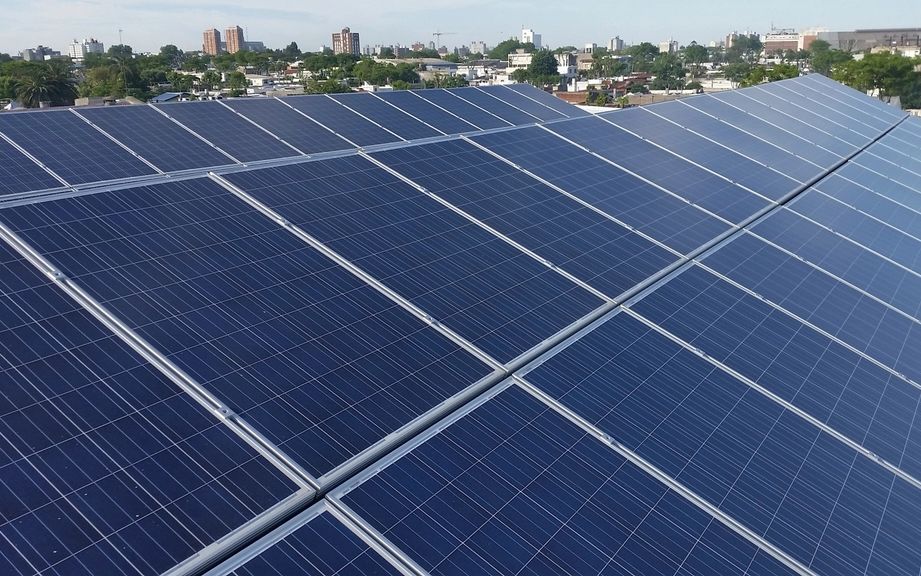
- At about 21 sq ft per panel, the panels themselves cover about 420 sq ft (39 m²) of roof, before spacing and setbacks.
Location makes a big difference
The same 900 kWh a month needs 29 panels (11.6 kW) with only 3 peak sun hours, but just 16 panels (6.4 kW) with 5.5 peak sun hours. Look up the figure for your address with a free tool such as NREL's PVWatts (US and many other countries), the European Commission's PVGIS (Europe, Africa, Asia) or your government's solar resource maps. These tools also account for roof tilt and direction.
Finding your electricity use
Add up the kWh on the last 12 bills, or download a year of usage from your utility's website. Using a full year matters because use and sunshine both change with the seasons. If you plan to add an electric car, a heat pump or other electric appliances, add their expected kWh: the EV charging calculator and electricity cost calculator help estimate them.
Should you cover 100%?
Whether it pays to cover all your use depends on how your utility credits exported power. Under full net metering, every exported kWh offsets an imported one, so covering 100% makes sense. Where exports earn less than you pay for imports, as under many newer tariffs, a smaller system matched to the power you use during the day, or a system with a battery, often pays back faster. Use the share-to-cover field to test smaller systems and the solar payback calculator to compare them.
Roof space and panel size
Modern residential panels are typically around 400–450 W and about 1.7–2.0 m² (18–22 sq ft) each. Fire codes and installers usually leave clear paths around the edges and ridge, so the usable area is smaller than the roof. South-facing roofs (north-facing in the southern hemisphere) produce the most; east and west roofs produce somewhat less but spread output across the day.
Adding a battery
A battery stores daytime surplus for the evening, which raises the share of your solar power you use yourself. It does not change how many panels you need to produce a given number of kWh, but it changes how valuable each kWh is when exports earn little. Use the battery backup calculator to size storage for your evening load.
Common mistakes
- Using hours of daylight instead of peak sun hours. A 12-hour summer day may be only 5–6 peak sun hours.
- Ignoring losses and shading. Even partial shade from a tree or chimney can cut output noticeably.
- Sizing from one summer bill. Use a full year.
Estimates only. An installer's site survey and production estimate are the figures to rely on.
Frequently asked questions
How many solar panels do I need for 900 kWh a month?
With 4.5 peak sun hours, 400 W panels and 14% losses, about 20 panels (8 kW). With 5.5 sun hours, about 16.
How do I calculate solar system size?
Yearly kWh ÷ (peak sun hours × 365 × (1 − losses)). 10,800 kWh with 4.5 sun hours and 14% losses needs about 7.65 kW.
What are peak sun hours?
The daily solar energy at your site expressed as hours of full 1,000 W/m² sunshine. Look it up for your address in PVWatts or PVGIS.
How much roof space do solar panels need?
Roughly 18–22 sq ft per panel; 20 panels at 21 sq ft is about 420 sq ft before spacing.
Sources
- National Renewable Energy Laboratory (nrel.gov). PVWatts Calculator: system losses and solar resource data.
- European Commission Joint Research Centre. PVGIS – Photovoltaic Geographical Information System.
- US Department of Energy, Solar Energy Technologies Office. Homeowner's guide to going solar.
Last reviewed 27 October 2026. Results are estimates; see our disclaimer.