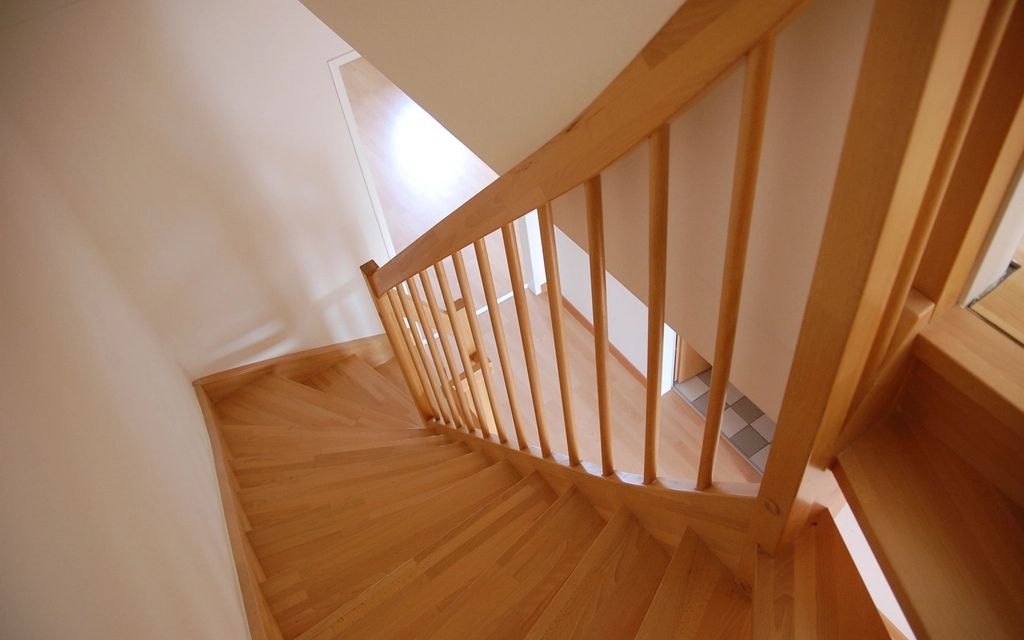
How stairs are calculated
Risers = total rise ÷ maximum riser height, rounded up
Riser height = total rise ÷ risers · Treads = risers − 1
Total run = treads × tread depth · Stringer length = √(rise² + run²)
Start with the total rise: the vertical distance from the finished surface of the lower floor to the finished surface of the upper floor. Divide it into equal risers no taller than the maximum allowed. Because the top step is the upper floor itself, a straight staircase has one fewer tread than risers.
Worked example: a 105 in floor-to-floor rise
- Risers: 105 ÷ 7.75 = 13.5, so 14 risers of 105 ÷ 14 = 7.5 in.
- Treads: 14 − 1 = 13 treads of 10 in, so the total run is 130 in (10 ft 10 in).
- Stringer length: √(105² + 130²) = √27,925 = 167.1 in (13 ft 11 in), so cut stringers from 16 ft boards to allow for the ends.
- Angle: arctan(7.5 ÷ 10) = 36.9°. Comfort check: 2 × 7.5 + 10 = 25 in.
Deck steps
A deck 30 in above the ground needs 30 ÷ 7.75 = 3.9, so 4 risers of exactly 7.5 in, and 3 treads. With 10 in treads the total run is 30 in, and the stringer is √(30² + 30²) = 42.4 in. Two 2×12 boards for the stringers (three for wider steps) are typical.
US residential code limits (IRC)
| Item | Requirement (IRC R311.7) |
|---|---|
| Maximum riser height | 7¾ in (196 mm) |
| Minimum tread depth | 10 in (254 mm), measured nosing to nosing |
| Variation between risers or treads | no more than ⅜ in (9.5 mm) in one flight |
| Minimum width | 36 in (914 mm) |
| Minimum headroom | 6 ft 8 in (2,032 mm) |
| Handrail | required on at least one side for four or more risers |
These figures come from the International Residential Code, which most US states and many cities adopt, sometimes with local changes. Other countries have different rules; for example, the UK's Approved Document K sets a maximum rise of 220 mm and a minimum going of 220 mm for private stairs, with a maximum pitch of 42°. Always check the code that applies where you live.
The comfort rule
Stairs feel natural when twice the riser height plus the tread depth comes to about 24–25 in (610–635 mm), close to a person's average stride. A 7 in riser with an 11 in tread gives 25 in, which is comfortable; a 7¾ in riser with a 10 in tread gives 25.5 in, steeper but still within code.
Things to allow for
- Finished flooring: measure the rise between finished surfaces. If flooring will be added later, account for its thickness at the top and bottom, or the first and last steps will differ from the others.
- Nosing: treads with a nosing overhang are deeper than the run. The IRC requires a nosing of ¾ to 1¼ in on stairs with solid risers when the tread is less than 11 in deep.
- Landings split a long flight into two shorter ones and must be at least as deep as the stair is wide.
Step by step: laying out a staircase
- Measure the total rise between finished floors at the exact spot where the stairs will land.
- Divide by the maximum riser height and round up to get the number of risers.
- Divide the rise by that number for the exact riser height.
- Multiply the number of treads by the tread depth for the total run, and check that the space is long enough.
- Check headroom along the whole flight before cutting stringers.
Common mistakes
- Counting treads equal to risers, which makes the top step a different height.
- Measuring to the subfloor instead of the finished floor.
- Rounding riser heights unevenly. Every riser must be the same, within ⅜ in.
Frequently asked questions
How many steps do I need for a 9 ft rise?
9 ft is 108 in. At a maximum of 7.75 in per riser, 108 ÷ 7.75 = 13.9, so 14 risers of 7.71 in and 13 treads.
What is the maximum stair riser height?
Under the US International Residential Code it is 7¾ in, with a minimum tread depth of 10 in. Local codes and other countries may differ.
How do I calculate stringer length?
Use Pythagoras: the square root of total rise squared plus total run squared. For a 105 in rise and 130 in run it is √27,925 = 167.1 in.
What is the ideal stair angle?
Between about 30° and 37° is comfortable for most homes. A 7.5 in riser with a 10 in tread is about 37°; a 7 in riser with an 11 in tread is about 32.5°.
How much space do stairs take up?
Multiply the number of treads by the tread depth. For a typical 105 in rise with 14 risers and 10 in treads, the total run is 130 in, or 10 ft 10 in, plus space for landings.
Sources
- International Code Council, 2021 International Residential Code (IRC), Section R311.7 Stairways.
- UK Government, Approved Document K: Protection from falling, collision and impact (private stair rise, going and pitch).
Last reviewed 20 October 2026. Results are estimates; see our disclaimer.