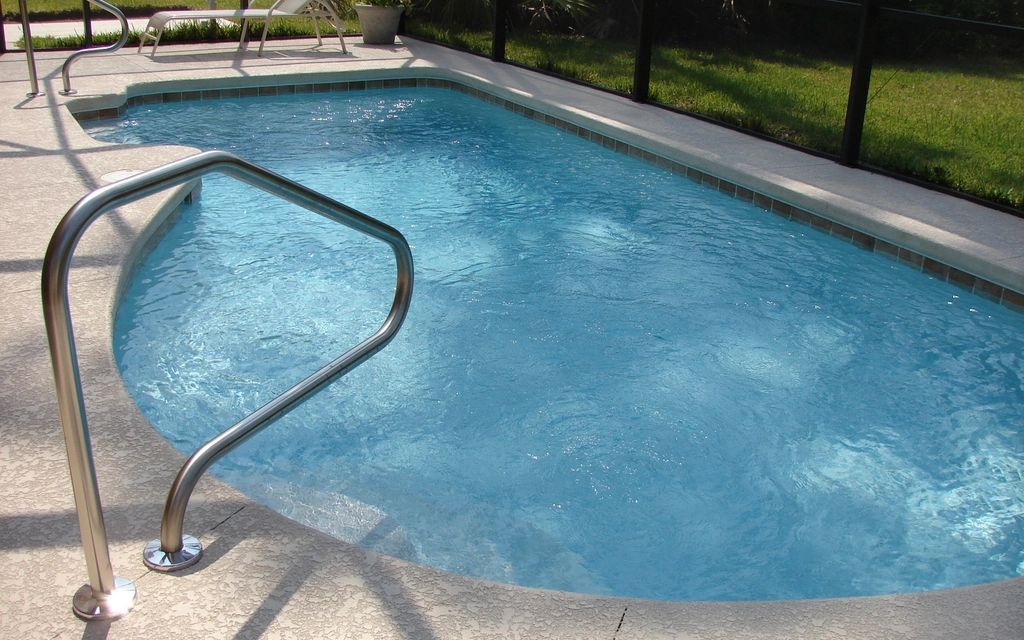
How a salt pool works
A saltwater pool is still a chlorine pool. The salt chlorinator (salt cell) passes a small electric current through lightly salted water and turns some of the salt into chlorine, which sanitises the pool and then turns back into salt. Salt is not used up by this cycle; it is lost when water leaves the pool through splash-out, backwashing, draining for rain, or leaks. So most of the time you only top up a little, and the big dose is when the pool is first filled or refilled.
Every chlorinator has a salt range printed in its manual and often on the control panel. Too little salt and the cell cannot make enough chlorine (and may shut down or wear faster); too much can trigger high-salt warnings and makes the water taste salty. Always use the target your manufacturer gives. Many residential cells ask for roughly 2,700–3,400 ppm, while some systems, including many in Australia and mineral pools, use higher levels; this calculator works with whatever target you enter.
Salt needed (kg) = (target ppm − current ppm) × litres ÷ 1,000,000
Salt needed (lb) = (target ppm − current ppm) × US gallons × 8.34 ÷ 1,000,000
Rule of thumb: 8.35 lb of salt raises 10,000 US gallons by 100 ppm
Worked examples
- New 15,000-gallon pool, 0 → 3,200 ppm: 400.6 lb (181.7 kg) of salt, about 10 bags of 40 lb.
- Same pool topped up from 2,400 to 3,200 ppm: 100.1 lb (45.4 kg), about 2.5 bags of 40 lb.
- 50,000-litre pool, 0 → 4,000 ppm: 200 kg, exactly 10 bags of 20 kg.
- Same pool from 3,000 to 4,000 ppm: 50 kg, or two and a half 20 kg bags.
How to add salt
- Test the salt level with salt test strips, a digital meter or at a pool shop. The reading on some chlorinator panels drifts, so confirm with a separate test before a large addition.
- Use pool salt: at least 99% pure sodium chloride, with no anti-caking agents, iodine or yellow prussiate of soda. Table salt and rock salt with impurities can stain.
- Turn the chlorinator off (or to standby) while adding salt, and leave the pump running.
- Pour the salt into the shallow end or around the edge, not into the skimmer, and brush it toward the main drain until it dissolves.
- Circulate for 24 hours, retest, then switch the chlorinator back on.
Add about three-quarters of a large dose first, then retest and add the rest. It is easy to add salt and much harder to remove it.
What if the salt is too high?
The only practical way to lower salt is dilution: drain some water and refill with fresh water. To bring 3,800 ppm down to 3,200 ppm you would need to replace about 16% of the pool water (1 − 3,200 ÷ 3,800). Check your local rules on draining saltwater before you do.
Common mistakes
- Trusting one reading. A dirty cell or a low water temperature can make the panel read low; confirm with a test strip or pool shop test before adding salt.
- Adding salt into the skimmer. A slug of saturated brine can damage equipment and the cell.
- Wrong volume. On a salt pool, a large volume error shows up as a salt reading far from what you expected. Measure it with the pool volume calculator.
- Ignoring the other numbers. Salt pools still need correct pH, alkalinity and stabilizer; the chlorine they make tends to push pH up. Use the pool chemical calculator.
Estimates only. Always use the salt range in your chlorinator's manual.
Pool salt chart
Salt needed to go from fresh water (0 ppm) to common targets, and to raise an existing pool by 500 ppm. Check your chlorinator manual for its own target.
| Pool size | 0 → 3,000 ppm | 0 → 3,200 ppm | 0 → 4,000 ppm | +500 ppm |
|---|---|---|---|---|
| 5,000 gal | 125.18 lb (56.78 kg) | 133.53 lb (60.57 kg) | 166.91 lb (75.71 kg) | 20.86 lb (9.46 kg) |
| 10,000 gal | 250.36 lb (113.56 kg) | 267.05 lb (121.13 kg) | 333.82 lb (151.42 kg) | 41.73 lb (18.93 kg) |
| 15,000 gal | 375.54 lb (170.34 kg) | 400.58 lb (181.7 kg) | 500.72 lb (227.12 kg) | 62.59 lb (28.39 kg) |
| 20,000 gal | 500.72 lb (227.12 kg) | 534.11 lb (242.27 kg) | 667.63 lb (302.83 kg) | 83.45 lb (37.85 kg) |
| 25,000 gal | 625.91 lb (283.91 kg) | 667.63 lb (302.83 kg) | 834.54 lb (378.54 kg) | 104.32 lb (47.32 kg) |
| 30,000 gal | 751.09 lb (340.69 kg) | 801.16 lb (363.4 kg) | 1,001.45 lb (454.25 kg) | 125.18 lb (56.78 kg) |
| 10,000 L | 66.14 lb (30 kg) | 70.55 lb (32 kg) | 88.18 lb (40 kg) | 11.02 lb (5 kg) |
| 25,000 L | 165.35 lb (75 kg) | 176.37 lb (80 kg) | 220.46 lb (100 kg) | 27.56 lb (12.5 kg) |
| 50,000 L | 330.69 lb (150 kg) | 352.74 lb (160 kg) | 440.92 lb (200 kg) | 55.12 lb (25 kg) |
| 75,000 L | 496.04 lb (225 kg) | 529.11 lb (240 kg) | 661.39 lb (300 kg) | 82.67 lb (37.5 kg) |
Salt is only lost when water leaves the pool, so after a heavy rain that overflows the pool, or a backwash, retest and top up rather than assuming the level is unchanged.
Frequently asked questions
How much salt do I need for a 15,000 gallon pool?
From fresh water to 3,200 ppm: about 400 lb (182 kg), or 10 bags of 40 lb. Use the target ppm in your chlorinator manual.
How much salt raises a pool by 100 ppm?
About 8.35 lb (3.79 kg) per 10,000 US gallons, or 1 kg per 10,000 litres.
How much salt for a 50,000 litre pool?
To reach 4,000 ppm from fresh water: 200 kg, ten 20 kg bags. To reach 3,200 ppm: 160 kg.
Can I use table salt in my pool?
Use pool salt, at least 99% sodium chloride with no anti-caking agents or iodine. Additives can stain surfaces or cause cloudy water.
How much salt do I need for a 20,000 gallon pool?
From fresh water to 3,200 ppm, about 534 lb (242 kg), or roughly 13 to 14 bags of 40 lb.
Sources
- Salt chlorinator manufacturers' owner manuals (salt range, adding salt, turning the cell off while it dissolves).
- Pool & Hot Tub Alliance (PHTA) and SPASA Australia: pool owner guidance on saltwater chlorination.
- 1 US gallon of water ≈ 8.34 lb; 1 ppm = 1 mg per litre.
Last reviewed 28 October 2026. Results are estimates; see our disclaimer.