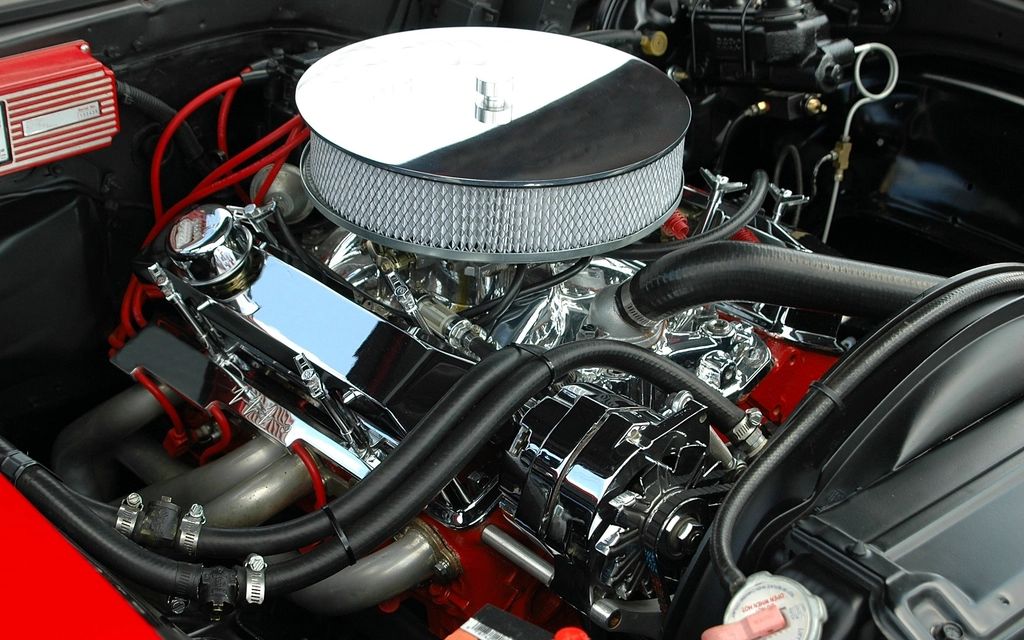
What displacement means
Displacement (also called engine capacity or swept volume) is the volume the pistons sweep as they move from the bottom to the top of their stroke, added up for all cylinders. It is the "1.6" in a 1.6-litre car or the "150" in a 150 cc scooter. It does not include the combustion chamber above the piston at top dead centre; that small extra volume matters for the compression ratio.
The formula
Each cylinder is a cylinder in the geometric sense, so its swept volume is the area of the bore times the stroke.
Volume per cylinder (cc) = π ÷ 4 × bore² × stroke ÷ 1000 (bore and stroke in mm)
Displacement = volume per cylinder × number of cylinders
Cubic inches = cc ÷ 16.387
Dividing by 1000 converts cubic millimetres to cubic centimetres (cc), which are the same as millilitres.
Worked examples
A four-cylinder car engine
Bore 86 mm, stroke 86 mm, 4 cylinders. One cylinder: 0.7854 × 86² × 86 ÷ 1000 = 499.6 cc. Four cylinders: 1,998 cc, sold as a 2.0-litre engine. In cubic inches that is 1,998 ÷ 16.387 = 121.9 ci.
A classic scooter bore-up
A classic 150 cc two-stroke scooter engine with a 57.8 mm bore and 57 mm stroke displaces 0.7854 × 57.8² × 57 ÷ 1000 = 149.6 cc. Fitting a 63 mm cylinder and piston on the same crankshaft gives 0.7854 × 63² × 57 ÷ 1000 = 177.7 cc, an increase of about 19%.
Bore versus stroke
- Square engine: bore equals stroke, as in the 86 × 86 mm example.
- Oversquare (short-stroke): bore larger than stroke. Room for bigger valves and higher revs; common in sports bikes.
- Undersquare (long-stroke): stroke longer than bore. Tends to give strong low-rpm torque; common in diesels and many economy engines.
Mean piston speed rises with stroke and rpm (mean piston speed = 2 × stroke × rpm ÷ 60), which is one reason long-stroke engines are usually limited to lower revs.
Bore-up and stroker kits
There are two ways to add capacity:
- Bore-up: a larger cylinder and piston. Because bore is squared in the formula, a small increase in bore adds a lot of capacity: going from 57.8 to 63 mm (+9% bore) adds about 19% volume.
- Stroker: a crankshaft with a longer throw. Capacity rises in direct proportion to the stroke.
Either change also raises the compression ratio unless the combustion chamber is enlarged, and usually needs matching changes to carburation or fuel injection, ignition and cooling. In many countries a change in engine capacity must also be declared for registration and insurance.
Rounding and marketing names
Manufacturers round displacement for model names, and tax bands are often based on the exact registered figure. A "1.6" engine may be anywhere from about 1,560 to 1,640 cc, and a "125" scooter is often 124.x cc to stay within licence rules.
Common mistakes
- Using radius instead of diameter. The formula uses bore (diameter) with π ÷ 4; if you use the radius, use π × r² instead.
- Mixing inches and millimetres. For bore and stroke in inches, multiply π ÷ 4 × bore² × stroke × cylinders to get cubic inches directly.
- Forgetting the cylinder count on multi-cylinder engines.
Typical engine sizes
| Engine | Total | Per cylinder |
|---|---|---|
| Small scooter | 50–125 cc | 50–125 cc (single) |
| Small three-cylinder car | about 1.0 L | about 333 cc |
| Family-car four-cylinder | 1.6–2.0 L | 400–500 cc |
| Large V8 | about 5.0 L | about 625 cc |
Displacement is not the same as power
A bigger engine can burn more fuel and air per revolution, so it tends to make more torque, but power also depends on rpm, turbocharging, valve timing and efficiency. Many modern 1.0–1.5 litre turbocharged engines produce as much power as older naturally aspirated engines of 2.0 litres or more. Use the horsepower and torque calculator to see how torque and rpm combine into power.
Why capacity matters on paper
Engine capacity often appears in vehicle registration, road-tax bands, insurance groups and driving-licence categories (for example, learner and small-motorcycle categories based on cc or power). Always use the exact registered figure from your documents for these purposes, not a rounded marketing number.
Frequently asked questions
How do I calculate engine cc?
Multiply π ÷ 4 by the bore squared and by the stroke (both in mm), divide by 1000 and multiply by the number of cylinders.
How many cc is a 2.0-litre engine?
About 2,000 cc. One litre is 1,000 cc, so 1,998 cc is marketed as 2.0 litres.
How do I convert cc to cubic inches?
Divide by 16.387. A 5,000 cc (5.0 L) engine is about 305 cubic inches.
Does a bigger bore or a longer stroke add more capacity?
Bore is squared in the formula, so a given percentage increase in bore adds roughly twice as much capacity as the same percentage increase in stroke.
Does a bigger engine always mean more power?
No. Power depends on rpm, turbocharging and engine design too; small turbocharged engines can outperform larger older ones.
How many cc per cylinder does a 2.0-litre four-cylinder have?
About 500 cc per cylinder.
Sources
- Heywood JB. Internal Combustion Engine Fundamentals, 2nd ed. McGraw-Hill, 2018 (engine geometry and swept volume).
- NIST Handbook 44, Appendix C: 1 cubic inch = 16.387064 cm³.
Last reviewed 5 October 2026. Results are estimates; see our disclaimer.