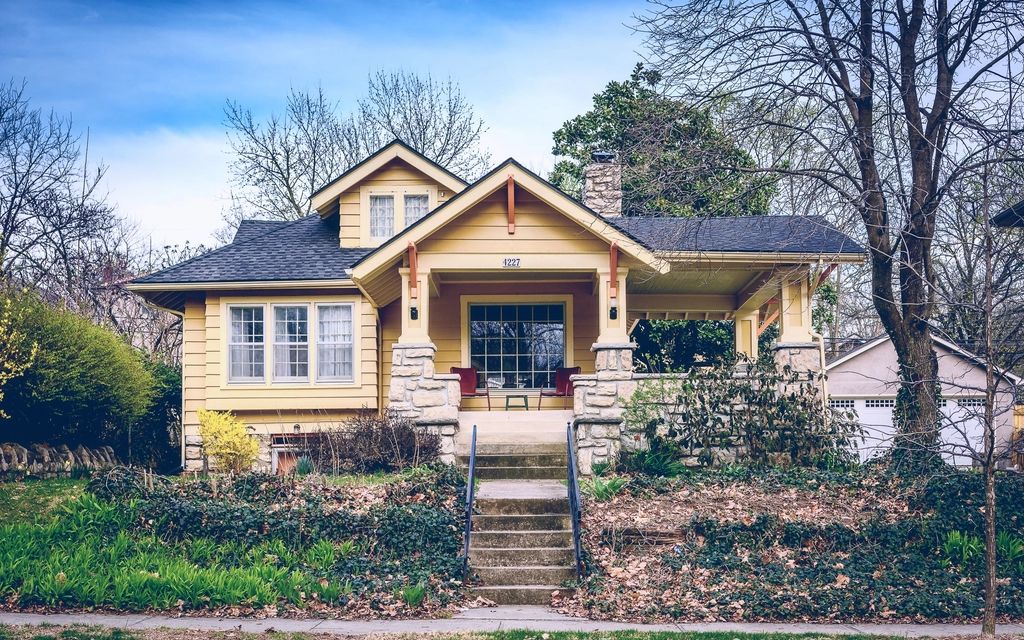
What BRRRR means
BRRRR stands for buy, rehab, rent, refinance, repeat. You buy a property that needs work, usually with cash or a short-term loan, renovate it, place a tenant, and then take out a long-term mortgage based on the higher after-repair value (ARV). If the new loan is large enough, it returns most or all of the money you put in, which you can use for the next property.
All-in cost = price + purchase closing + rehab + holding costs + refinance closing
New loan = ARV × refinance loan-to-value
Cash left in the deal = all-in cost − new loan
Cash flow = rent × (1 − vacancy) − operating expenses − new mortgage payment
If you bought with a short-term (hard money or private) loan, enter its balance: the refinance pays it off first, and only your own cash counts as invested. Interest, points and fees on that loan belong in holding costs, together with property tax, insurance and utilities paid while the house was empty.
Worked example
An investor buys a house for $150,000 with $4,500 of closing costs, spends $40,000 on the rehab and $6,000 on holding costs. An appraiser values the finished house at $260,000. A lender refinances at 75% loan-to-value with $5,000 of closing costs and a 30-year rate of 7.25%. Rent is $2,100, vacancy 5% and operating expenses $650 a month.
- All-in cost: 150,000 + 4,500 + 40,000 + 6,000 + 5,000 = $205,500, which is 79% of ARV.
- New loan: $260,000 × 0.75 = $195,000; after $5,000 of costs, $190,000 comes back.
- Cash left in the deal: 205,500 − 195,000 = $10,500.
- New payment: $1,330.24 a month. Cash flow: 1,995 − 650 − 1,330 ≈ $15 a month.
- Equity after the refinance: 260,000 − 195,000 = $65,000.
The refinance worked (only $10,500 stays in), but at a 7.25% rate the property barely breaks even each month (DSCR 1.01). That is the trade-off at the heart of BRRRR: pulling more cash out means a bigger loan and less monthly cash flow.
If the appraisal comes in at $240,000 instead, the 75% loan is only $180,000, $25,500 stays in the deal, and the smaller loan leaves about $117 a month of cash flow. If the purchase and rehab had been funded by a $155,000 hard money loan, the same refinance would first repay that loan, return $35,000 of the $45,500 the investor put in, and still leave $10,500 in.
The 75% rule of thumb
Because many cash-out refinances on investment property are limited to around 70–75% of the appraised value, BRRRR investors try to keep the all-in cost at or below that share of ARV. In the example the all-in cost is 79% of ARV, so some cash stays in. The calculator shows the all-in percentage so you can see how close a deal is before you buy.
Risks the numbers do not show
- Appraisal risk: the whole plan depends on the ARV. Base it on recent sales of comparable renovated homes, not on the most optimistic listing.
- Seasoning: many lenders require you to own the property for some months before they will lend on the new value rather than your purchase price. Ask lenders about their rules before you buy.
- Rate risk: the refinance happens months after the purchase, at whatever rates apply then. Test a higher rate.
- Rehab overruns and delays add both cost and holding time. A contingency of 10–20% of the rehab budget is common.
- Thin cash flow: a property that only breaks even has no buffer for a vacancy or a large repair.
For the full multi-year picture of the finished rental, use the rental property calculator; if you plan to sell instead of renting, use the house flip calculator.
Frequently asked questions
How much cash can I pull out in a BRRRR?
The new loan is the appraised after-repair value times the lender's maximum loan-to-value, often around 70–75% for investment property cash-out refinances. Subtract refinance costs and any short-term loan you must repay.
What is a good BRRRR deal?
One where the all-in cost (purchase, closing, rehab, holding and refinance costs) is at or below the share of ARV the lender will lend, and the rent still covers the new mortgage and all expenses with room to spare.
What if the appraisal comes in low?
The loan is smaller, so more of your cash stays in the property. Your cash flow improves because the payment is lower, but you have less money for the next deal.
Do holding costs include hard money interest?
Yes. Put interest, points and fees on the short-term loan, plus tax, insurance and utilities while the property is being renovated, into holding costs.
Is BRRRR cash-on-cash return infinite?
If the refinance returns all of your cash and the property still has positive cash flow, the ratio has no finite value. The return is real, but so is the larger loan and its risk.
Sources
- Fannie Mae. Selling Guide B2-1.3-03, Cash-Out Refinance Transactions.
- Consumer Financial Protection Bureau. Buying a house: tools and resources.
Last reviewed 3 November 2026. Results are estimates; see our disclaimer.